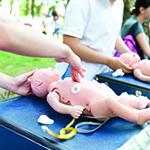
Mock Code Blue Simulation provided in varying units across the hospital.

NCHF Transport Quarterly Skills 2024_Quarter 1 NICU (3 of 3)

This Transport Quarterly Skills session will focus on transport team skills related to the care of the critically ill neonate. Join the interprofessional transport team in the simulation lab to document your competencies in umbilical venous line placement and needle thoracostomy. Learners will also review Tecotherm Setup for Induced Hypothermia, TXP Setup/Use, and participate in a Neonatal Transport Simulation lead by the NCH Neonatology Department. This live session has limited space for NCHF associates only and prioritizes the NCHF Transport Team members. 

Please login or register to take this course.
  • 1.00 Continuing Education
    This activity is designated for 1.00 continuing education credits.
  • 1.00 Nursing Contact Hour – Florida Board of Nursing

    Provider approved by the Florida Board of Registered Nursing. Provider number # 50-1428.

    This activity is designated for 1.00 contact hours.

NCHF Transport Quarterly Skills 2024_Quarter 1 NICU (2 of 3)

This Transport Quarterly Skills session will focus on transport team skills related to the care of the critically ill neonate. Join the interprofessional transport team in the simulation lab to document your competencies in umbilical venous line placement and needle thoracostomy. Learners will also review Tecotherm Setup for Induced Hypothermia, TXP Setup/Use, and participate in a Neonatal Transport Simulation lead by the NCH Neonatology Department. This live session has limited space for NCHF associates only and prioritizes the NCHF Transport Team members. 

Please login or register to take this course.
  • 1.00 Continuing Education
    This activity is designated for 1.00 continuing education credits.
  • 1.00 Nursing Contact Hour – Florida Board of Nursing

    Provider approved by the Florida Board of Registered Nursing. Provider number # 50-1428.

    This activity is designated for 1.00 contact hours.

Experience the dynamic world of emergency medicine through our ED in-situ simulation program. Calling all interprofessional medical professionals in the ED to participate in this immersive education experience in the comfort of your own resuscitation bay.

Embark on a transformative learning journey with our interprofessional hospital team simulation, dedicated to fostering effective teamwork and communication. We invite all hospital team members to participate and explore the intricacies of collaborative healthcare.

This simulation is designed to teach clinicians evidence based neonatal resuscitation techniques to support a neonate in distress.

Critical care units rely on high functioning interprofessional teams to respond to clinical emergencies. Team skillsets can vary based on experience levels of members, patient conditions, and team makeup and thus, impact an emergency response.

This is an intensive one-day course designed for DELAWARE EMS providers who would like more experience in managing pediatric scenarios. We will provide hands on training in critical pediatric assessment and procedure skills. This will include pediatric specific airway management techniques, vascular access, immobilization, and resuscitation procedures. Using high fidelity simulation, this course will also focus on the crisis resource management skills needed to successfully manage a critically ill pediatric patient.

Pages

Subscribe to RSS - Simulation